Nylon Lines (Polyamide)
The most popular products in Nylon Lines (Polyamide) in our shop



All 5 articles in Nylon Lines (Polyamide) at a glance
Fish on! You have it almost at the net – and then comes that one hard head-shake. With a no-stretch connection that passes the shock on almost unbuffered, the hook would be out right now. Not with nylon: the line gives for a split second, cushions the blow, and the fish stays on. That is exactly the moment the classic monofilament still exists for.
Real stretch for safety during the drill
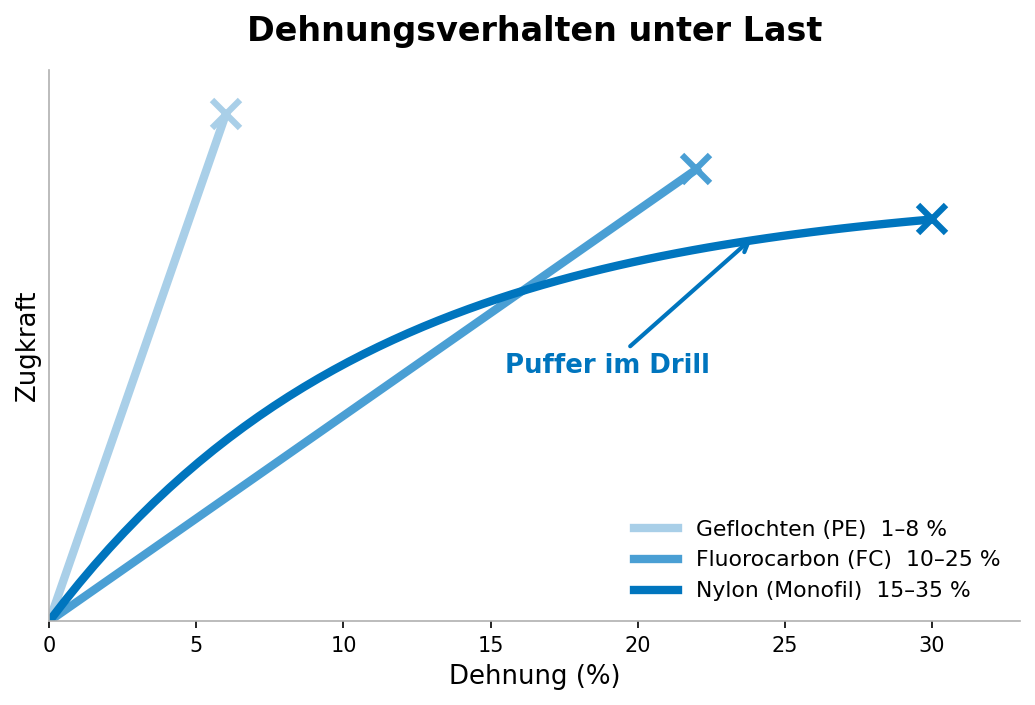
Its key advantage is stretch: around 15 to 35 percent. It works like a shock absorber, cushioning runs, jumps and head-shakes at close range – before the hook tears out of a soft mouth. When targeting trout, chub, perch or asp, it saves critical situations that would otherwise have been lost, even when the drag or rod is set a touch too hard.
The flip side is only fair to mention: that same stretch costs you feel. Lure contact softens, bite detection at distance gets less precise – more so with every metre of line. For monofilament line spinning, nylon is therefore the ideal choice for short to medium range and forgiving drills – in the ultra-light range for perch and trout up close, for instance – not for sensitive finesse at long range.
Well camouflaged – invisible until the bite
A monofilament is a single strand of nylon – extremely round, extremely smooth. That makes it quiet off the spool, supple through the guides and ideal when you want to cast light lures far and cleanly.
In clear water, even a cautious trout, a wary chub or an asp under pressure barely grows suspicious – because in its transparent standard form, nylon is very discreet. It plays these strengths as a leader too, and because it floats unlike fluorocarbon, it perfectly suits topwater mono line setups where the lure is meant to stay on the surface.

How nylon ranks against braided line and fluorocarbon in breaking strain, abrasion resistance and visibility is shown in the direct comparison on our Fishing Line page. In short, it sits in the balanced middle for most properties – nowhere the specialist, but solid everywhere. The chart shows at a glance where its strengths lie.
Stay calm all the way to the fish
In the end it is this one feeling that the right line is about: the good fish is near the net, makes its final run – and you do not have to panic. Because the stretch works with you and gives you the reserve a too-hard moment would otherwise never forgive. Nylon takes the stress out of the close-range drill.
To let it show that fully, match it cleanly to your rod, reel and target fish. As a premium trout monofilament line or for perch and chub, you will find the right class in our selection of monofilament lines – so you stay calm while others lose their fish.