Braided Fishing Line – Direct Feedback for Jigging
The most popular products in Braided fishing line with near-zero stretch: 4-, 8- and 16-strand PE for direct feedback, maximum casting distance and control. in our shop


All 15 articles in Braided fishing line with near-zero stretch: 4-, 8- and 16-strand PE for direct feedback, maximum casting distance and control. at a glance
That hard perch or pike tap you feel travel all the way across the rocks and into the rod handle, before you even think to react – that is the moment braided line was made for. No other line transmits so directly what is happening at the lure.
Perfect Feedback, Maximum Distance
The reason lies in its build: a braided line (PE, polyethylene) is made of several fine fibres woven together – under the microscope, it looks like a rope. Exactly that gives it, at a tiny diameter, a tensile strength a single fibre like monofilament can never reach.
Its second big advantage is extremely low stretch – many times lower than nylon. That gives you direct contact with the lure, lets you maintain perfect bottom contact and detect even the most cautious bites. It matters most at long range, because stretch would build up with every metre of line – with braid, it simply does not. In a crosswind a second effect shows: the floating braid forms a bow on the surface, while a sinking fluorocarbon leader steers the lure more directly.
The PE system – an honest rating instead of a guessed mm value
Browsing our braids, you will notice most carry a „PE #“ rating rather than a millimetre value. There is a good reason for that. The cross-section of a braided line is never perfectly round, so mm figures for PE are technically inaccurate – and are often exaggerated on the packaging. The Japanese PE system (the Goh system) instead measures the exact fibre weight per length and gives you an honest, comparable value. You will find the full conversion from PE class to diameter and tensile strength on our Fishing Line page.
4-carrier, 8-carrier or 16-carrier braid – what is the difference?
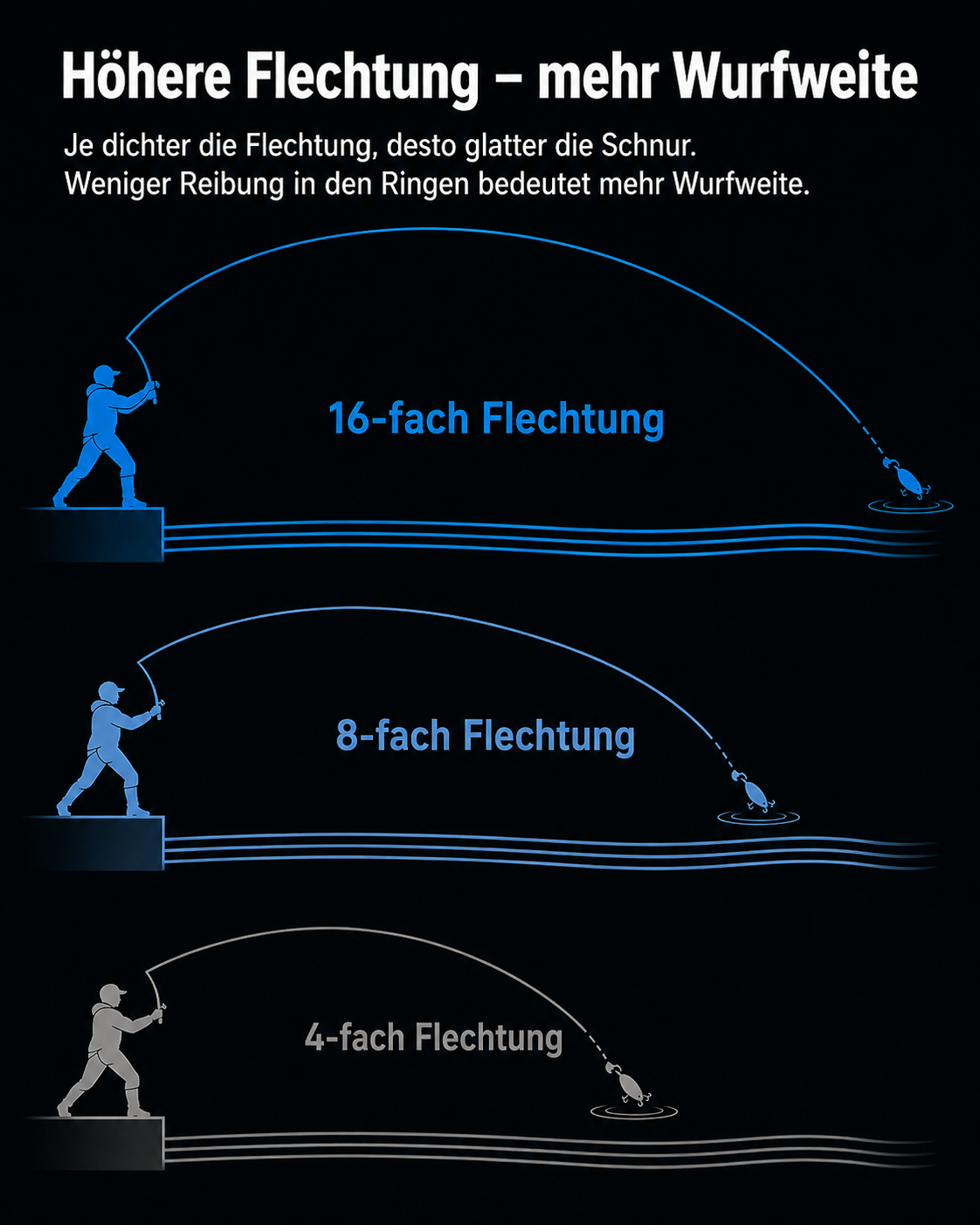
The number stands for how many strands are braided together. As a rule of thumb: the more strands, the rounder and smoother the line – an advantage for casting distance, knot strength and lure control. Fewer but thicker strands make the line rougher, yet especially tough. There is no „better“ here, only the right tool for your fishing method:
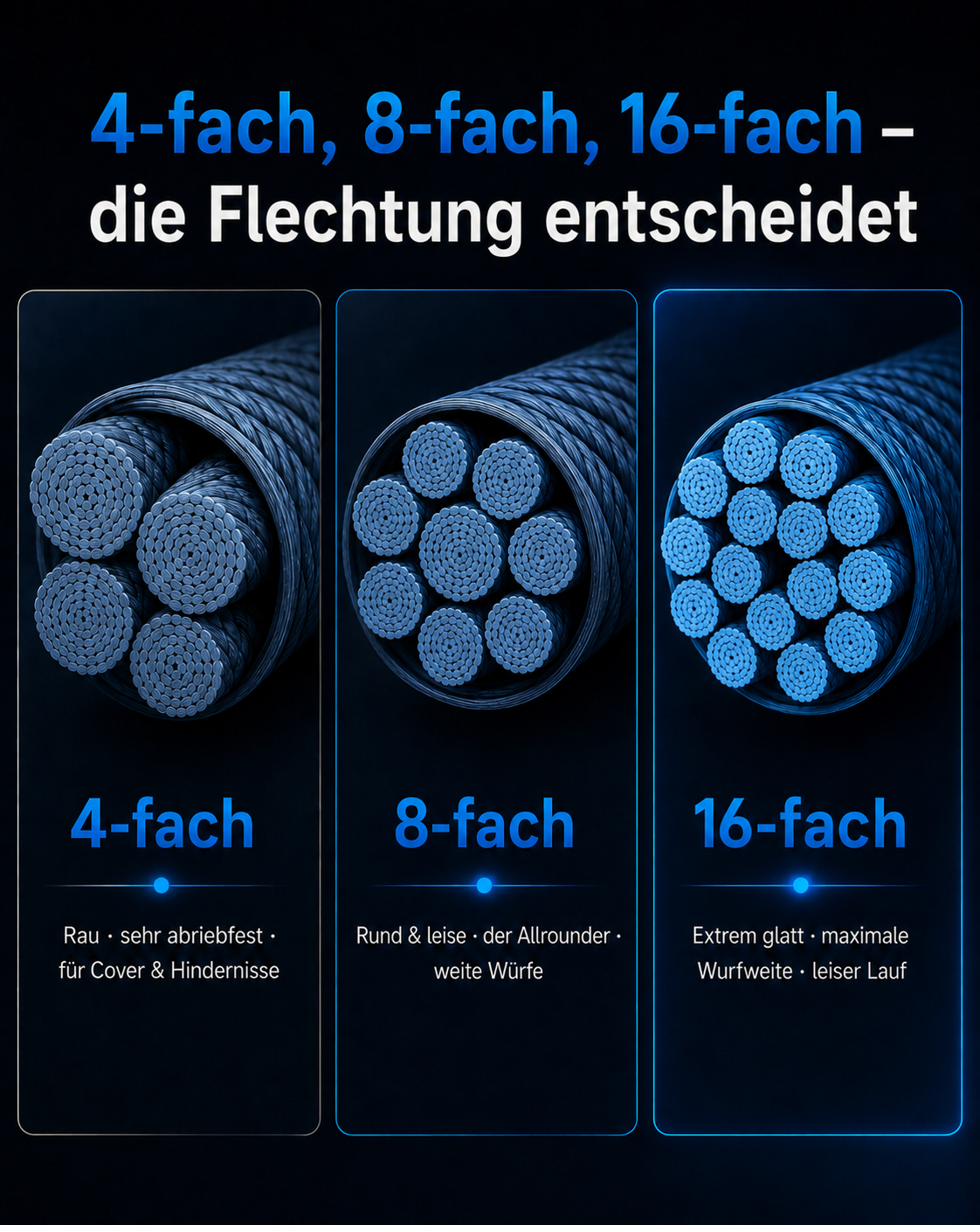
| Property | 4-carrier | 8-carrier | 16-carrier |
|---|---|---|---|
| Casting distance | solid | high (low friction) | maximum |
| Guide noise | audible, slightly sawing | quiet | nearly silent |
| Best used for | heavy cover, weed, snags | the all-rounder | long casts, fine finesse |
4-carrier braid has a practical edge many underrate: in thin diameters, it lays neatly onto a baitcaster spool because it is not quite so round – it digs in less and helps prevent those annoying backlashes.
Modern 8-carrier braids keep closing the gap, though, and remain the first choice for the vast majority of techniques: round, quiet, and long-casting. 16-carrier is the specialist for maximum casting distance and a silky-smooth run – though a little more sensitive to sharp edges in return.
Sure which braid suits your method? Then you will find it in our selection of braided lines.
Which line colour for zander, perch & co.?
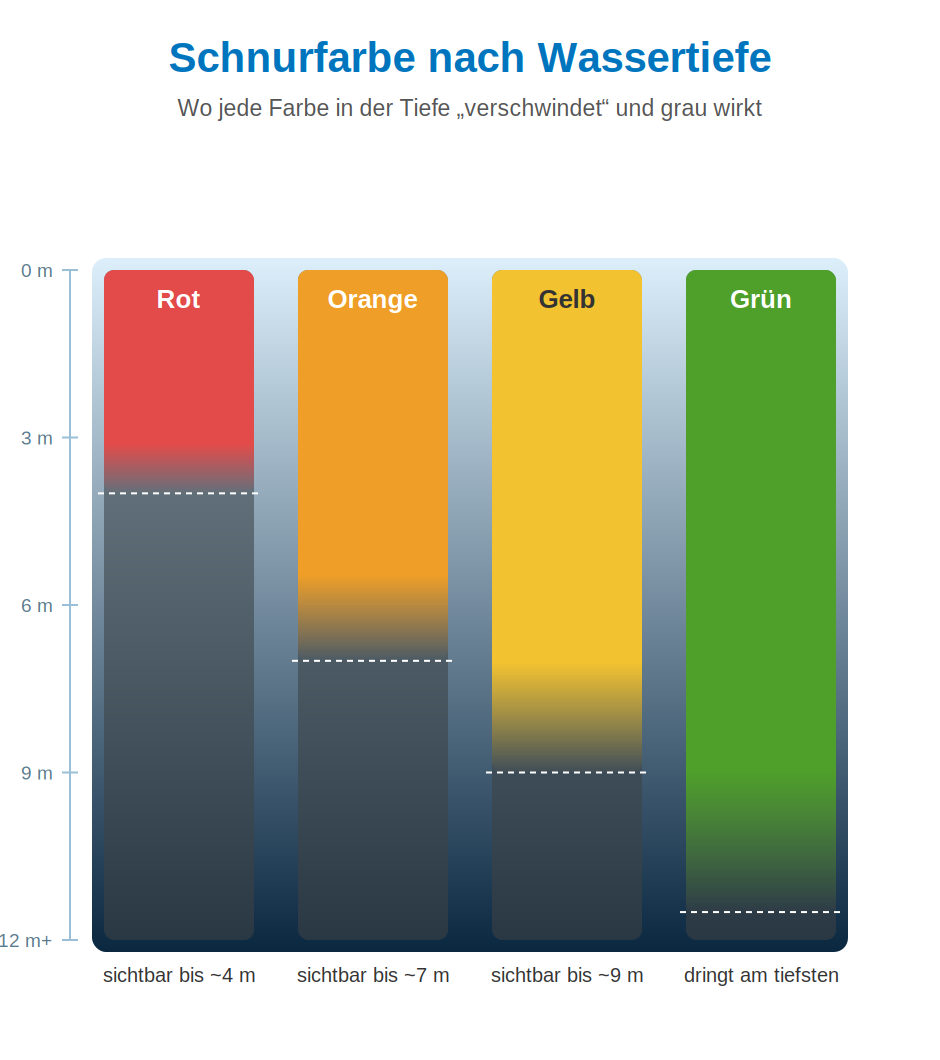
With braid, colour is not decoration but tactics. If you fish constantly under tension – with crankbaits or swimbaits, for example – you do not need to see the line at all; the rod signals the bite. It is a different story with drop-shot, jigging or other rigs: here, bites often come so gently that you only spot them as a twitch of the line. Depending on the sun and water clarity, that is nearly impossible with an invisible line. That is when highly visible colours like yellow, orange, red or hi-vis green pay off – they act as your visual bite indicator.
The other way round: in very clear water or when targeting pressured fish, a bright main line can spook them. The solution is always the same – a discreet fluorocarbon or nylon leader at the lure, while the coloured braid up top takes care of casting distance and bite detection.
No perfect combo without the right line
A braid only shows its strengths when it matches the rest of your tackle. Balance tensile strength and diameter to your rod, reel and technique – as well as to the target fish and how it fights. On a river with heavy current and lots of structure, go one class stronger: that gives you an abrasion reserve and the power to pull lures out of snags before you break off. The better everything works together, the further you cast and the more effectively you can work your lure.
And because braid has almost no stretch, a leader almost always belongs at the end: it cushions hard lunges, keeps the presentation stealthy and – where pike are around – bite-proof.