Leader Material – Titanium & Fluorocarbon for Predators
The most popular products in Teeth, rocks or clear water? Leader material in bite-proof titanium and abrasion-resistant fluorocarbon – matched to your target fish. in our shop


All 8 articles in Teeth, rocks or clear water? Leader material in bite-proof titanium and abrasion-resistant fluorocarbon – matched to your target fish. at a glance
Rod, reel and lure can all be perfect – in the end it is the last few centimetres that decide between landing the fish and going home frustrated. Razor-sharp pike teeth, mussel-covered rock, gin-clear water: the right leader protects your rig and fools the wary predator. The table below shows you in seconds which material fits your target fish.
Teeth, rocks or clear water – The right leader material for your target fish
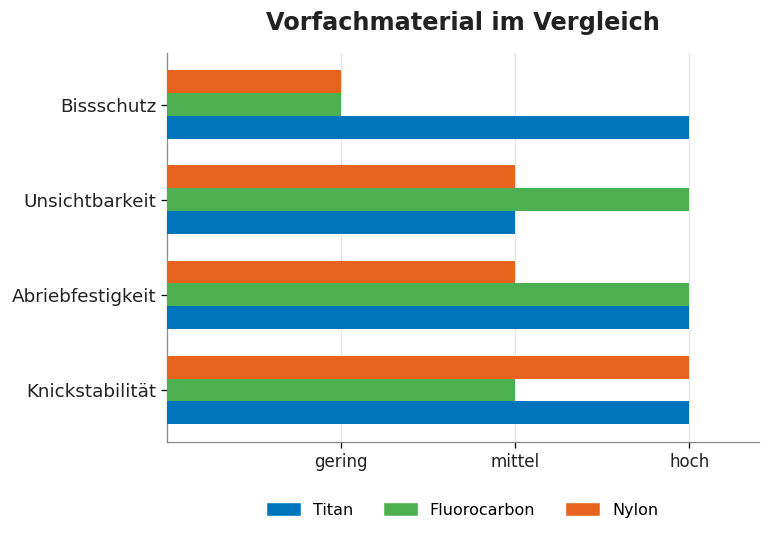
Each of the three dangers has its own answer. Only bite-resistant material stops teeth, only abrasion resistance survives rock, and only a discreet line beats sharp eyes in clear water. No single material does everything at once. Instead of chasing a “universal” solution, you pick exactly what covers the greatest danger for your target fish.
| Target fish | The biggest danger on the water | The right material |
|---|---|---|
| Perch in clear water | Visibility: Line-shy fish that spook easily in clear water | Fluorocarbon (discreet) |
| Zander along rock | Abrasion: Rough bottom, sharp edges, mussel beds | Fluorocarbon (abrasion-resistant) |
| Pike | Teeth: A razor-sharp bite, instant cut-off | Titanium (bite-resistant / pike-proof) |
| Perch/zander with pike by-catch | Conflict: Fine presentation needed, but bite-off risk | Fine titanium |
| Trout, no tooth contact | Cushion: Hard head-shakes, hook pulls in the fight | Nylon (supple) |
As soon as a pike could be in the water, there is no way around bite-resistant material. Those razor-sharp teeth cut through fluorocarbon and nylon in seconds – and even thick material is no guarantee once the fish rolls in the fight and the line catches between the teeth at a bad angle. Titanium is the modern premium answer here: it is highly kink-resistant and has zero memory, springing back straight after a hard bite instead of bending for good. That means fewer changes, more time on the water – and a leader you trust in the day-to-day chase for predators.
Where there are no teeth but sharp eyes and rough ground, fluorocarbon plays to its strengths. Its refractive index is close to that of water, making it virtually invisible below the surface and convincing exactly the cautious fish a visible mainline would spook. It is also more abrasion-resistant than soft nylon and stands up longer to grinding on rock edges and mussel beds. Thanks to its higher density fluorocarbon sinks, which makes it ideal for bottom-contact presentations – the first choice for perch and zander in clear water and on hard ground. Which material hides behind this as a line class in its own right, you can read on the Fluorocarbon page.
And then there are the situations where suppleness and cushioning count: a soft nylon or copolymer leader absorbs violent head-shakes and provides excellent shock absorption on the strike, and knots beautifully – a good choice when neither tooth contact nor maximum abrasion protection are the priority, for example finesse fishing for perch, zander and trout.
Why the last few centimetres of your fishing line decide everything
Why not just tie the lure straight to the mainline? Because it is exactly there, on the last few centimetres before the lure, that the three greatest dangers meet: the sharp teeth of a pike, the rough edges of rock and mussel beds – and the suspicious eye of a big perch in clear water. A braided mainline is conspicuous, vulnerable to abrasion and utterly defenceless against teeth. The leader takes this weak point out of the rig.
A break-off costs more than a lure. In the worst case the fish is left with the hook and lure in its mouth. That is why choosing the right leader does not start with “what is the strongest?”, but with your target fish, the water and the greatest danger to your rig.
The breaking-strain fallacy – How the right match protects your line

A leader rated at “10 kg” does not mean your rig carries 10 kg. Between material and fish sit knots, swivels and snaps – and every knot costs strength. The chain is only as strong as its weakest link. So always look at breaking strain and diameter together: two “10 kg leaders” can be completely different in thickness.
From this follows an idea that saves your expensive mainline: the deliberate breaking point. If the leader is tuned one step weaker than the mainline, then on an unsolvable snag in timber or rock the rig breaks exactly at the leader knot – you only lose a hook or a snap. If the leader is stronger, the line gives somewhere out on the spool instead, and many metres of costly braid are left behind in the water. What matters is that you know where your rig is meant to give in the extreme case – the uncontrolled version is the bad one for both your wallet and the water.
The pike-proof rig
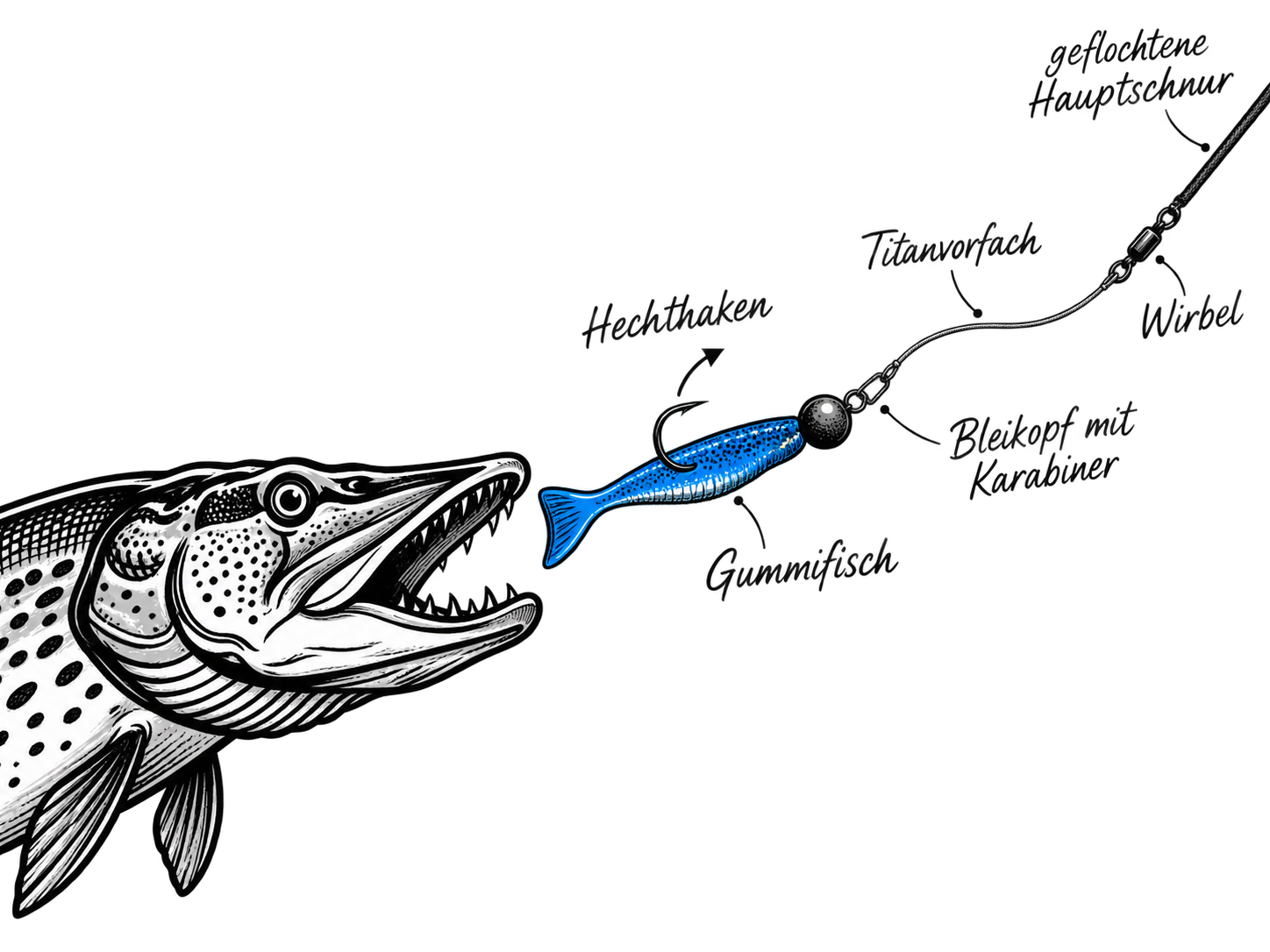
This is how the parts work together: from the braided mainline a swivel leads to the bite-resistant titanium leader, which connects via a snap to the jig head and soft bait. Every link has its job – and none may become the weak point. That is what a leader is all about: building the last few centimetres so the teeth never reach the unprotected mainline.
The right choice brings you the fish
It is not the most expensive or the strongest leader that brings you the fish, but the one that matches your target fish, water and rig: ultra-fine fluorocarbon for the big perch in clear water, kink-proof titanium for the pike hunt. Match it cleanly to your pike rod and your pike lures – then you act on the water instead of only reacting. Make the last few centimetres of your rig secure, and stay calm in the moment that counts.